To Be With
Intimacy / Dependence / Mediation / Distance / Relationship
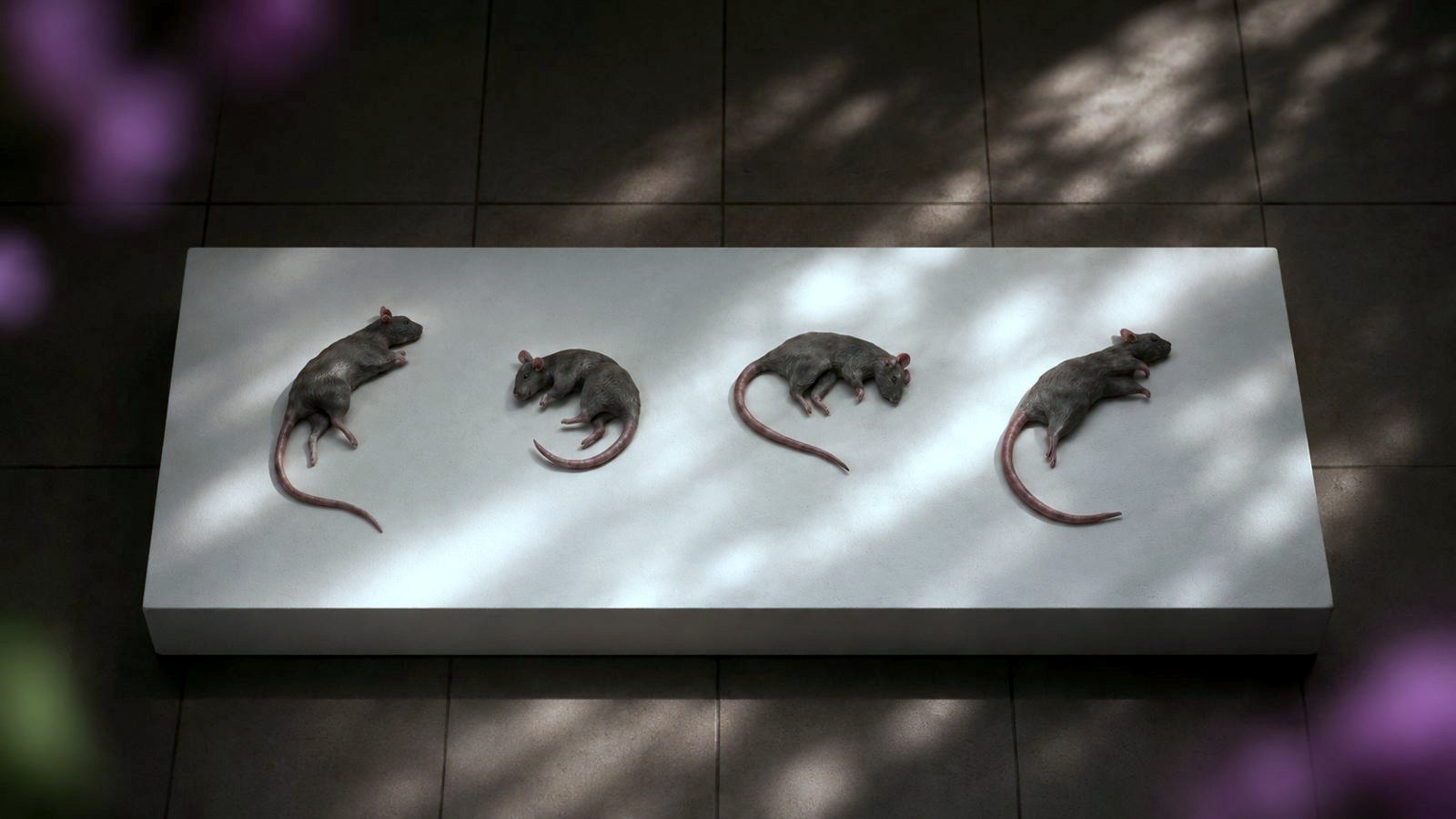
Relationships begin within the self. Before any encounter takes place, care, control, fragility, and responsibility are already in dialogue. These inner figures negotiate constantly, whether in conflict or in fragile balance. These internal dynamics quietly structure how closeness and distance are lived with others. What appears as a relational problem often echoes an inner configuration. To be with someone else therefore means to also confront what remains unresolved within oneself. There is no neutral position towards another. Every relationship is already inhabited.
TO BE WITH approaches relationships as moving systems that are shaped by mediation, dependence, and difference. The exhibition brings together works that explore relationships as processes rather than outcomes –– being configurations that exist only while remaining in motion.
Several works in the exhibition address relationships as relations of mutual dependence. Balance here is never guaranteed. In works where bodies rely on each other for stability, support and vulnerability appear inseparable. To lean on another is always to accept the risk of falling. Relationships do not eliminate instability; they produce it, replacing autonomy with a sense of responsibility, explicit or implicit, toward the other and toward the space that opens between separate beings.
Other works focus on mediation as a fundamental condition of intimacy. Relationships here are not presented as immediate. They are always shaped by language, bodies, memory, and technology. Voices travel without bodies. Communication bridges distance while simultaneously making distance visible. What is transmitted is not full presence, but a trace –– a remainder and a reminder of contact. Telephone lines, recorded voices, spectrograms, and obsolete communication technologies appear as material witnesses of this condition: they connect us while emphasising absence. Intimacy here is never pure but constructed through layers of mediation, delay, and longing.
The exhibition also engages with relationships across time — including those marked by loss, interruption, or disappearance. Gardens that no longer grow, voices that remain after bodies are gone, traces left behind by those who will not return: these works point to relationships that continue without active exchange. Movement emerges as a condition of life. When movement stops, the relationship may still exist in memory or structure, but something essential is lost. What remains is form without vitality.
At the same time, TO BE WITH resists the idea that closeness means fusion. To be with others does not mean to merge into a single whole. Closeness does not cancel difference, but exposes it, showing togetherness as coexistence instead of unity. Being with another always means remaining separate at the same time. Distance does not oppose intimacy, but inhabits and accentuates it. In this way every relationship contains a gap that cannot and should not be closed, as it is the very pre-condition for connection. Without it, there is no relation — only absorption.
Relationships in this exhibition unfold as sequences of states: longing, closeness, withdrawal, anticipation, rupture, return. They circulate rather than progress, hesitating, repeating, breaking, and reconfiguring. Love, friendship, and intimacy are not shown as paths toward harmonious resolutions, but as ongoing processes that cannot be finalized. To relate with someone is actually to remain in perpetual movement.
Finally, TO BE WITH proposes that relationships extend beyond interpersonal bonds. They unfold between internal figures, between bodies and technologies, between humans and non-human forms, between past and present. Hybrid organisms, entangled structures, and shared systems of becoming suggest forms of togetherness in which difference is not erased, but sustained. Fragility and resilience exist side by side.
TO BE WITH does not offer solutions, ideals, or instructions, holding tension rather than resolving it. Between closeness and distance, dependence and autonomy, presence and absence, the exhibition invites viewers to stay with complexity.
More exhibitions