Please stay the night, I feel so lonely without somebody
Longing / Intimacy / Projection / Digital life / Loneliness
There is something almost embarrassing about wanting to be loved today. Wanted for a moment, replied to, desired, flirted with, briefly obsessed over — and underneath all of it, the exhausting desire to feel genuinely cared for by another person. To want closeness now often feels excessive, uncool, and strangely humiliating. Contemporary culture encourages permanent emotional exposure while simultaneously punishing sincerity. We are expected to confess constantly, yet remain detached enough to never fully mean it. We shift between dating apps, typing indicators, therapy language, memes, ghosting, screenshots, ironic self-awareness, and algorithmic self-curation. Our emotional life has become both hyper-visible and increasingly impossible to articulate honestly.
Please Stay the Night, I Feel So Lonely Without Somebody by Marcin Gajewski exists precisely inside this contradiction.
The exhibition moves through emotional states that contemporary culture often treats as uncomfortable or excessive: longing, limerence, dependency, projection, emotional overstimulation, the obsessive desire to be understood, the inability to stop wanting even after desire has already become painful. These feelings are rare, but deeply familiar. The exhibition reflects on something that many people quietly experience: receiving attention does not necessarily dissolve loneliness. Being answered does not end longing. Sometimes desire multiplies through contact itself.
Gajewski approaches these conditions with both brutal sincerity and subtle absurdity. There is humor throughout the exhibition, but it is the kind that appears when emotional intensity reaches a point of self-awareness. The works understand the awkward theatre of contemporary intimacy: rehearsed vulnerability, over-explanation, emotional performance, carefully managed authenticity, the exhausting pressure to remain emotionally available while never appearing emotionally “too much.”
Drawing from 1990s anime, internet language, graffiti, and digital communication, Gajewski builds a visual world where emotional expression appears fragmented, unstable, repeated, distorted. His text works function like unfinished confessions or thoughts looping internally at 3am — messages written impulsively, deleted, rewritten, screenshotted, overanalyzed. Language throughout the exhibition fails repeatedly to fully stabilize feeling. Words become both emotional release and emotional malfunction.
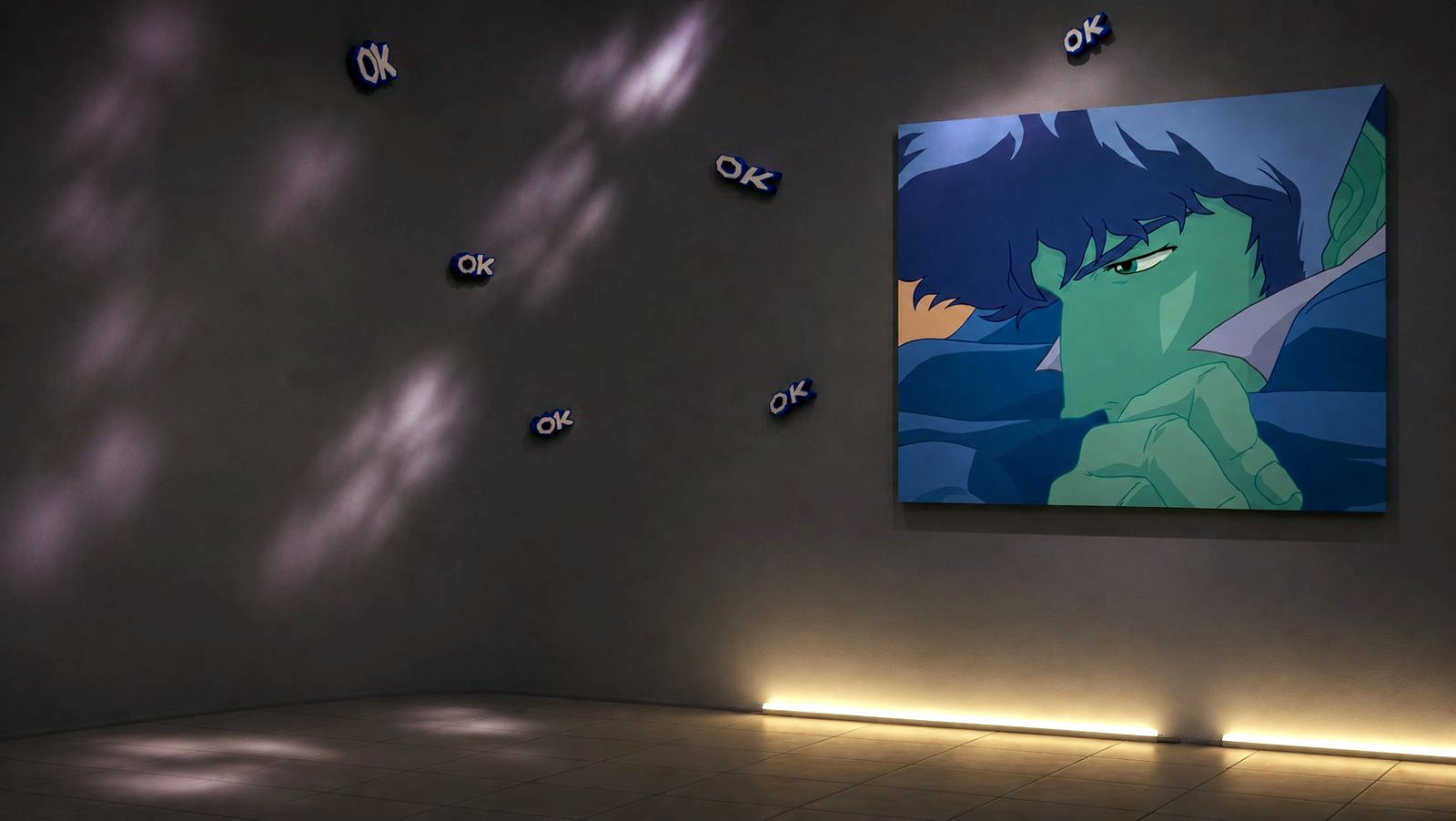
The large-scale portraits occupy a particularly tense psychological space. Rather than functioning as nostalgic references or illustrations of characters, they operate more like emotional surfaces onto which viewers project themselves. Their expressions resist full readability. Faces linger somewhere between vulnerability and withdrawal, emotional collapse and restraint, desire and shame. Gajewski isolates the exact threshold where emotion begins becoming visible but has not yet fully solidified into action or explanation.
The use of anime becomes important precisely because these faces are not fully human. Their slight artificiality creates space for projection. Simplified lines somehow hold enormous emotional complexity, allowing viewers to enter the works through recognition rather than narrative. Many of the source materials originate from 1990s dystopian science fiction — stories deeply concerned with identity, alienation, mediation, technological loneliness, and psychological fragmentation. It feels less like nostalgia, highlighting a strange historical loop: these imagined futures now resemble our emotional present.
The wooden sculptures introduce another important tension within the exhibition: the collision between digital emotionality and physical material. Internet language, fleeting in-app expressions, reaction culture, emotional exaggeration, fragmented communication — all become translated into carved walnut forms. Something usually temporary, impulsive, or immaterial suddenly gains physical weight. Desire hardens into objecthood. Emotional residue becomes sculptural.
What makes the exhibition compelling is that Gajewski never fully resolves the tension between sincerity and performance. The works remain aware of their own emotional excess while refusing to retreat into irony. They ask what happens when contemporary subjectivity becomes shaped almost entirely through mediated emotional expression — when people increasingly learn intimacy through interfaces, projection through images, and selfhood through performative visibility.
At its core, Please Stay the Night, I Feel So Lonely Without Somebody circles around a very contemporary kind of emotional hunger: the endless desire to be recognized, mirrored, chosen, emotionally witnessed by another consciousness. A desire that often survives even fulfillment. A desire simultaneously intensified and destabilized by digital life. And perhaps that is what feels so emotionally unsettling about the exhibition. Beneath all the humor, stylization, references, and emotional performance, the works reveal something disarmingly simple: most people are still desperately trying to reach each other, while having less and less language capable of carrying the full weight of what they feel.
Artists
More exhibitions